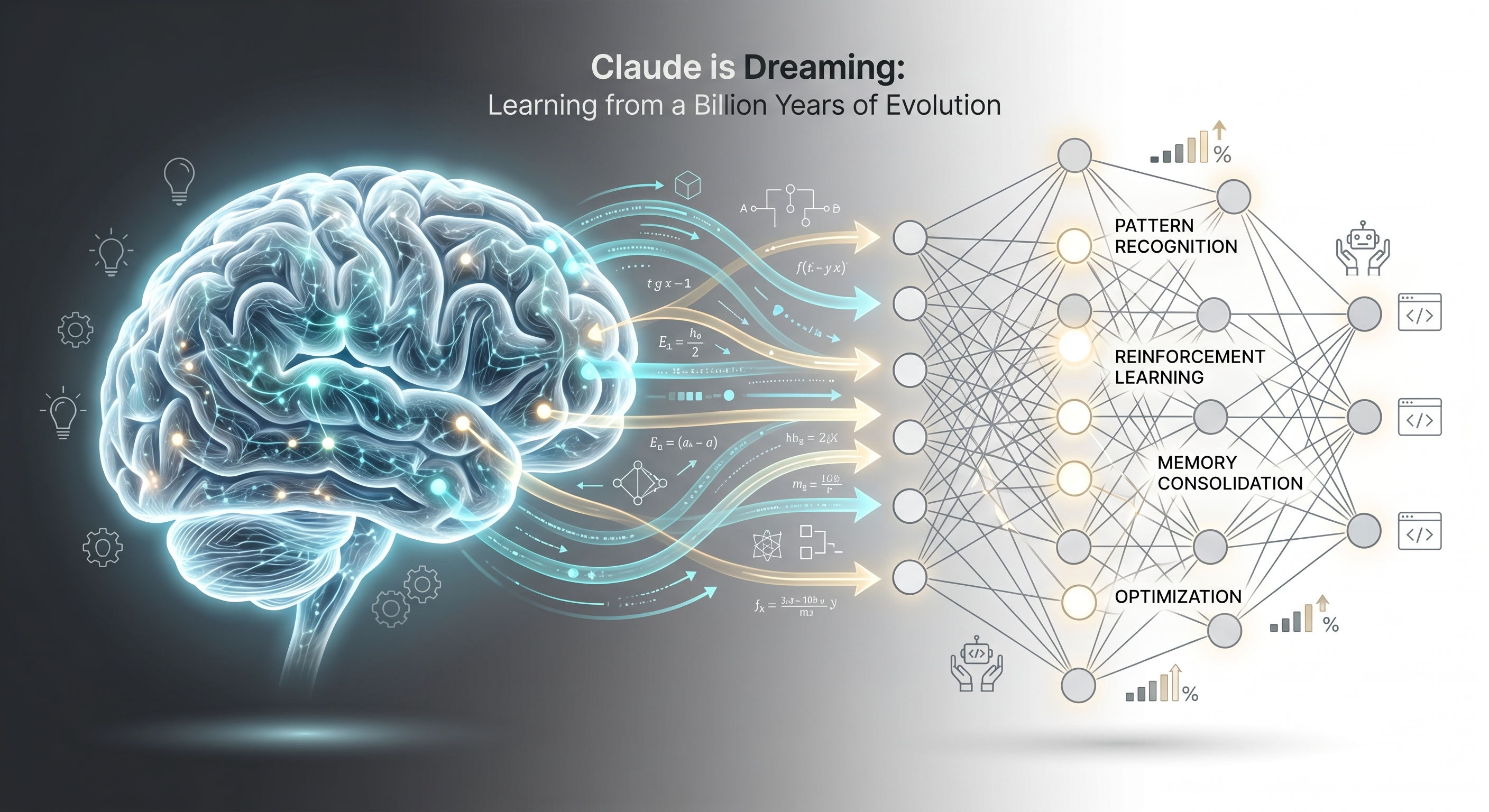
Claude is Dreaming: How Anthropic Borrowed a Billion Years of Evolution to Fix AI Memory
I was reading about Anthropic's new Dreaming feature last week and I had to put my phone down for a moment.
Not because the technology was impressive. Because I had read this exact idea three weeks ago in a book about the human brain.
I have been going through A Brief History of Intelligence by Max Bennett lately. His core argument is this: every major AI breakthrough we have ever built was copied from the brain's evolutionary history. Neural networks, reinforcement learning, attention mechanisms — all of it reverse engineered from how our neurons actually work. We did not invent intelligence. We kept borrowing it from biology, one discovery at a time.
And then I read about Dreaming.
The Problem Every AI Agent Has Right Now
Most AI agents wake up every morning with full amnesia.
Every session. Every single time. No matter how well they performed yesterday. The model receives a prompt, does excellent work, the context window closes, and it starts completely fresh the next time. Brilliant within a session. Completely stateless between them.
It is like hiring someone who does outstanding work but walks in every Monday remembering nothing from the previous week.
This is not a minor inconvenience. For teams running agents in production — on legal workflows, document review, code generation, customer support — this statelessness is the single biggest gap between what agents can do in a demo and what they can reliably do in the real world.
What Anthropic Actually Shipped
On May 6, 2026 at their Code with Claude conference in San Francisco, Anthropic announced Dreaming as a research preview feature for Claude Managed Agents.
The mechanism is straightforward once you understand what it is trying to solve.
When you enable Dreaming on a managed agent, Anthropic schedules a background process that runs between sessions. It reads through the agent's recent session transcripts and its existing memory store. It looks for three specific things:
- Recurring mistakes the agent keeps making across jobs
- Workflows the agent independently converges on across different tasks
- Preferences and patterns shared across a team of agents working in parallel
It then produces a reorganized, consolidated memory store that the next session can use. Duplicates get merged. Stale or contradicted entries get replaced. New patterns that no single session could surface on its own get written as fresh insights.
Critically, the original memory store is never touched. Enterprises can review the output and discard it entirely if they do not like what the process produced.
Typical runs take minutes. Designed to run overnight or during off-peak windows.
Agent Session 1 ──┐
Agent Session 2 ──┤──► Dreaming Process ──► Consolidated Memory Store
Agent Session 3 ──┘         │                        │
                    (Runs between sessions)    (Next session starts here)
                    - Find recurring mistakes
                    - Surface shared patterns
                    - Merge and reorganize
                    - Original left untouched
This is not retraining. The model weights do not change. It is closer to structured note-taking that runs automatically on a schedule. The agent reflects, consolidates, and comes back to the next job sharper.
Where I Had Read This Before
Bennett's book traces five evolutionary breakthroughs in how biological intelligence developed over 600 million years. One of the most important is sleep-based memory consolidation.
While you sleep, your hippocampus replays the day's experiences. It strips out irrelevant noise, reinforces patterns that appeared across multiple experiences, and moves useful knowledge from short-term into long-term memory. You wake up subtly better at things without consciously trying. Bennett frames this as one of the core leaps that separates creatures locked in instinct from those that accumulate genuine wisdom across a lifetime.
The parallel to Dreaming is not metaphorical. It is structural.
Both processes share the same design:
| Biological Brain | Claude Dreaming |
|---|---|
| Runs during sleep, offline from active tasks | Runs between sessions, asynchronous |
| Replays recent experiences | Reads recent session transcripts |
| Finds patterns across multiple days | Finds patterns across multiple sessions |
| Consolidates into long-term memory | Writes reorganized memory store |
| Original experience not modified | Original memory store left untouched |
| You wake up having learned | Agent starts next session having learned |
Anthropic's own documentation frames the feature with this exact analogy. The neuroscience framing is not marketing. It is the actual design rationale.
The Results From Early Deployments
Harvey, the legal AI company and one of Anthropic's most visible enterprise customers, had been running Dreaming internally before the public launch.
Their task completion rates rose roughly 6x in internal testing once Dreaming was enabled. Harvey's team noted the feature worked best when paired with tight outcome rubrics, so any drift in memory would be caught and corrected on the next consolidation run.
Wisedocs, a medical document review company, cut document processing time by 50 percent using the companion Outcomes feature that shipped alongside Dreaming.
Netflix is now processing logs from hundreds of simultaneous builds using the multi-agent orchestration feature that shipped in the same release.
How to Think About This If You Are Building Agents
Dreaming is currently in research preview. It supports select Claude models and operates under default rate limits. Access requires requesting it through Anthropic's platform.
A few things worth understanding before you design around it:
It is not a replacement for good session memory. Dreaming works at a higher level of abstraction than session memory. Session memory captures what happened in one conversation. Dreaming finds patterns across many conversations. You need both.
Context window constraints still apply. Even with a well-consolidated memory store, Claude can only work with what fits in its current context window. Large memory stores need smart retrieval logic to be useful. Not every memory should be loaded for every session.
The original inputs are always preserved. This matters for enterprise deployments. You can review exactly what Dreaming produced, compare it to the original, and reject it if the consolidation went wrong. This is the safety valve that makes it practical in regulated industries.
Pair it with outcome rubrics. Harvey's experience suggests the combination of Dreaming and well-defined outcome evaluation creates a feedback loop where agents improve reliably rather than randomly.
What Comes Next, According to the Book
Bennett's book kept echoing in my head as I read through the announcement. His argument is that AI progress has always followed the brain's evolutionary roadmap, and that until AI systems replicate each of the core breakthroughs in that history, they will keep falling short of genuine intelligence.
Dreaming was on that list. Now it is checked.
Neuroscience labs are currently doing some genuinely interesting and occasionally absurd research that signals what comes next.
Scientists are studying how the brain runs two completely separate systems for instinct and rational thought and somehow keeps them from fighting each other most of the time. Anyone who has tried to diet while standing next to a bakery understands this system is imperfect, but it exists and it is sophisticated.
Researchers are mapping how curiosity is hardwired as a survival mechanism, not a personality trait. Your brain literally rewards you with dopamine for going down Wikipedia rabbit holes at midnight. This is not a bug. It is a feature that evolved because exploring unknown information increased survival odds. No AI agent today has anything close to this built in.
There is also serious work being done on how humans build detailed mental models of other people's intentions before a single word is spoken. We are constantly running predictive simulations of other minds, updating them in real time based on tiny signals. It is how we navigate social situations, negotiations, and conversations. AI cannot reliably do this yet.
The funny part is that for decades we thought sleep was the brain doing nothing. Turns out it was doing everything important. We just could not see it from the outside.
AI researchers are now in the same position with half the brain's remaining features. They know something interesting is happening in the neuroscience literature. They just have not figured out how to engineer it yet.
The next decade of AI is not going to be built primarily in a machine learning lab. It is going to be borrowed, piece by piece, from neuroscience papers that most people in the industry have not read yet.
Bennett's book might already have the table of contents.
If you are building agents in production and want to think through how memory architecture affects your specific workflows, let's talk.
The full Anthropic announcement with technical details on Dreaming, Outcomes, and Multi-agent Orchestration is on the Anthropic blog.