The Machine That Passed the Medical Exam but Cannot Feel a Handshake
On embodied AI, neuromorphic chips, quantum computing — and why we may have built something that is neither artificial nor human.
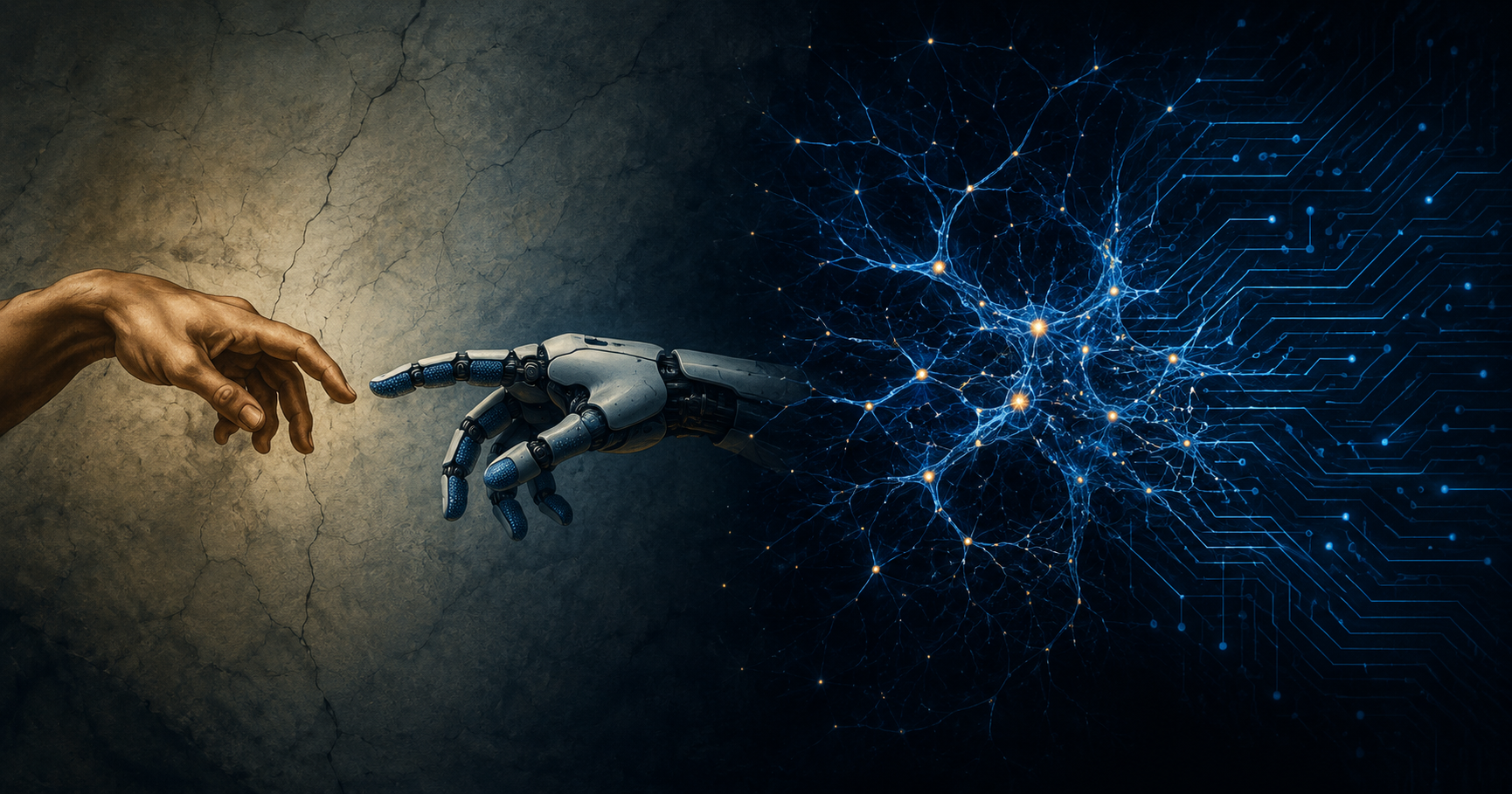
I build AI systems for a living. RAG pipelines, agents that translate natural language into SQL, voice bots that hold conversations in regional Indian languages. I've watched these systems do things that would have seemed like magic five years ago. And the longer I work with them, the more convinced I am that we've been describing them wrong — to our clients, to the public, and to ourselves.
Here is the uncomfortable engineering fact underneath all the demos: a modern large language model can pass a medical licensing exam, and it cannot feel a handshake. It can describe the warmth of a palm, the firmness of a grip, the social weight of the gesture — it has read millions of descriptions of all of it. It has experienced none of it. There is no sensor, no body, no moment of contact anywhere in the system.
That gap isn't a missing feature. It's a clue about what we've actually built.
Matrix Multiplication at Scale Is Not a Brain
Strip away the abstraction layers and current AI is matrix multiplication at extraordinary scale. Tokens become vectors, vectors get multiplied through hundreds of layers of weights, and the output is a probability distribution over the next token. It works astonishingly well. It is also, architecturally, nothing like a brain.
Consider the numbers. The human brain runs on roughly 20 watts — about what a dim light bulb draws. It has on the order of 100 trillion synaptic connections. Our largest models sit somewhere around 1–2% of that connectivity, cost hundreds of millions of dollars to train, and require data centres with dedicated power infrastructure. The brain learns "hot" from one touch of a stove and never forgets it. A model needs billions of examples and still generalises in ways that occasionally embarrass it.
The brain also does something no transformer does: it integrates touch, temperature, proprioception, emotion, and memory simultaneously, in the same wet tissue, with no separation between sensing, computing, and learning. There is no inference phase and training phase. There is just living.
When the efficiency gap between two systems is six orders of magnitude, you're not looking at an optimisation problem. You're looking at a different kind of computation. Three research directions are taking that seriously.
1. Embodied AI — Closing the Grounding Gap
Philosophers call it the grounding problem; engineers run into it as a bug report. A child learns "hot" from one experience — the burn binds the word to a body, an emotion, a memory, all at once. A language model learns "hot" from billions of text descriptions of hotness, and at the end of training it has a statistically perfect map of how the word is used and zero knowledge of what hot feels like. The symbol is not grounded in anything. It floats.
Embodied AI is the attempt to put the floor back under the symbols.
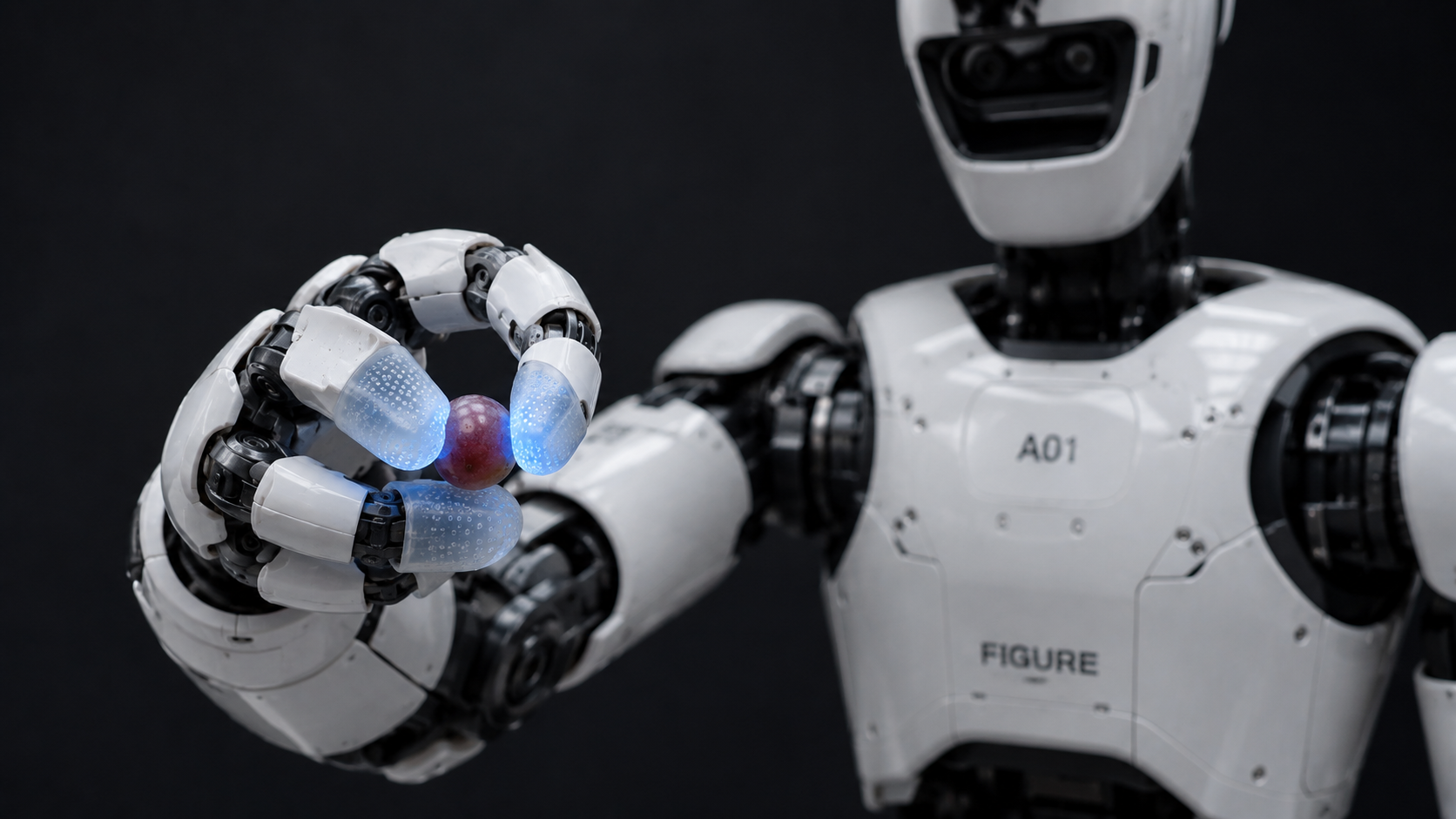
Meta's work here is more interesting than the metaverse headlines suggested. DIGIT is a compact, vision-based tactile fingertip sensor — a silicone pad with a camera behind it that reads deformation at high resolution, cheap enough (~$15 in bill of materials at volume) to put on every finger of a robot hand. ReSkin, built in collaboration with Carnegie Mellon University, is a deformable elastomer skin with embedded magnetic particles. When it deforms, nearby magnetometers read the change in magnetic field, and a learned model converts that into contact location and force. Robots with ReSkin can grasp grapes without crushing them. That sentence sounds trivial until you try to write the control loop yourself.
On the action side, Google DeepMind's RT-2 treats robot actions as just another language:
Vision input → Language model → Action tokens → Motor commands
The same architecture that completes your sentences moves an arm. And Figure AI is putting this whole stack into humanoid form, with demos of robots handling objects and performing tasks learned from observation rather than hand-coded control loops.
None of this gives a machine experience. But it does something subtler: it forces the model's representations to answer to physics. A grip that's wrong gets corrected by the world, not by a loss function over text. That's the first real crack in the grounding problem — not solved, but finally being attacked with hardware instead of philosophy papers.
2. Neuromorphic Chips — Computing the Way Neurons Do
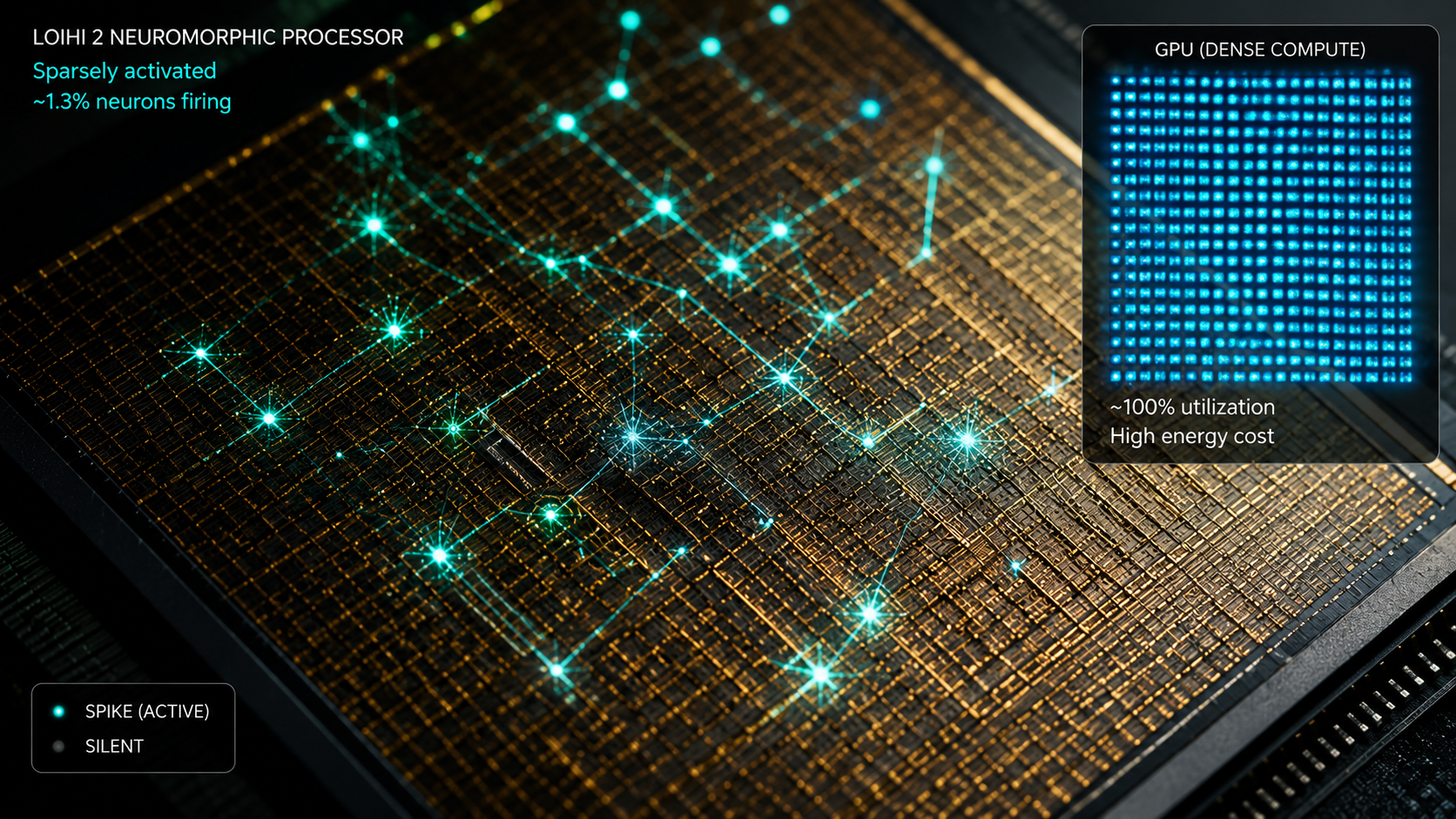
The second direction goes after the energy gap, and it starts from a blunt observation: GPUs compute the way GPUs compute, not the way brains compute. A GPU multiplies dense matrices on a fixed clock, moving data back and forth between memory and compute — the classic von Neumann bottleneck — burning energy whether the computation is interesting or not.
Neurons don't do that.
GPU:  tick → multiply → tick → multiply → (constant energy draw)
Neuron: silence → silence → SPIKE → silence → silence → SPIKE
         (energy only on event)
A neuron fires a spike only when its inputs cross a threshold. No input, no spike, no energy. Computation is event-driven, asynchronous, and sparse — and memory lives in the same place as processing. The synapse is both the weight and the storage.
Spiking Neural Networks (SNNs) replicate this in silicon.
Intel's Loihi 2 packs up to a million spiking neurons per chip with programmable neuron models and on-chip learning rules. The chip can adapt its weights locally, without a backpropagation pass through a data centre. IBM's NorthPole attacks the architecture from another angle, eliminating the memory/compute separation entirely by weaving memory through the compute fabric — on image recognition benchmarks it delivered dramatically better energy efficiency and latency than comparable GPUs at the same task.
The headline number across the field: a potential 1000x energy improvement for sparse, event-driven, sensory workloads — which is exactly what an embodied robot generates. A tactile sensor mostly reports nothing. Until the object slips.
I want to be careful here. Neuromorphic computing has been "five years away" for twenty years. The tooling is immature, training algorithms don't transfer cleanly from deep learning, and nobody has trained anything GPT-class on spikes. But it is the only computing paradigm we have that is even shaped like biology. And if the brain's 20 watts tells us anything, it's that the shape matters enormously.
3. Quantum Computing — The Honest Assessment
Every article in this genre ends with quantum computing as the deus ex machina. I'm going to break with that convention, because the honest assessment is more useful than the hyped one.
Where quantum genuinely helps: simulating quantum systems. Molecular dynamics, materials discovery, drug-candidate chemistry — problems where nature itself is quantum mechanical and classical computers must approximate exponentially complex state spaces. Certain combinatorial optimisation problems also show real promise. If quantum computing transforms AI, it will likely be by transforming the data — letting us simulate molecules and materials we currently can't — not the training loop.
Where it doesn't help: training transformers. There is no proven exponential quantum speedup for the dense matrix multiplications that dominate deep learning. The quantum linear-algebra algorithms that exist come with brutal caveats around data loading and readout that typically erase the theoretical advantage in practice. Anyone telling you quantum computers will train GPT-7 is selling something.
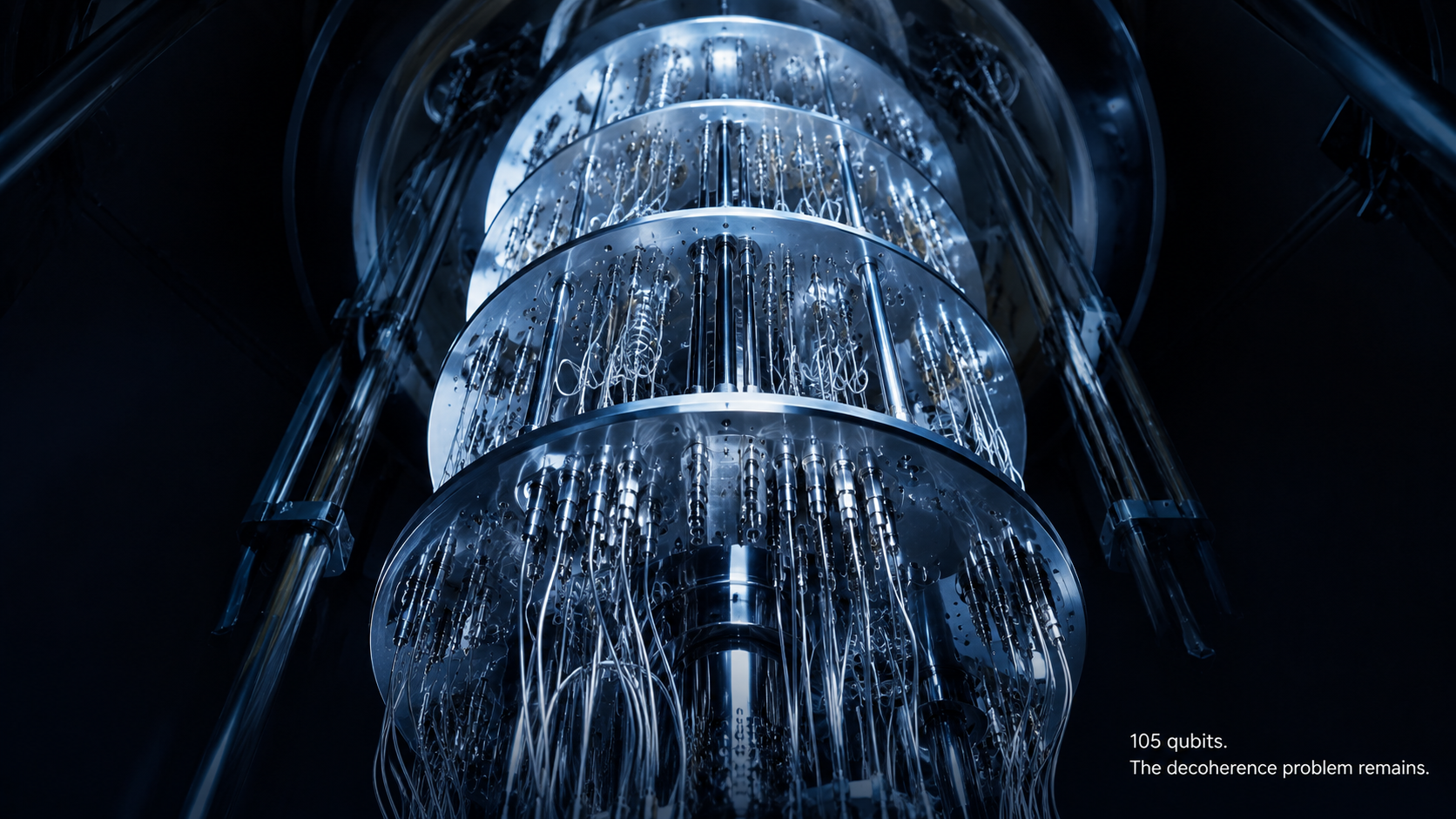
Where we actually are: Google's Willow chip demonstrated 105 physical qubits — and the genuinely important result was that error rates decreased as the qubit array scaled up. That's the first convincing experimental evidence that quantum error correction can outrun the noise. IBM's roadmap pushes toward error-corrected logical qubits over the coming years.
Current state:
  Physical qubits  : 105 (Google Willow)
  Coherence time   : microseconds
  Physical qubits needed per logical qubit: ~1000
  Useful fault-tolerant computation: not yet
Decoherence remains the central enemy. Qubits hold their quantum state for microseconds before the environment destroys it. We are genuinely early. Respect the physics. Ignore the press releases.
Neither Artificial nor Human
Now put the three threads together and look at what's emerging. A machine with magnetic skin that feels an object slipping and tightens its grip. A chip that learns from single events through local spikes, drawing milliwatts instead of kilowatts. Eventually, perhaps, simulation capabilities that let these systems model the physical world at the molecular level.
What is that?
It is not artificial intelligence, in the sense the founders of the field meant — a recreation of human cognition in silicon. The architecture is wrong, the learning is wrong, the energy budget is wrong. And it is obviously not human intelligence. It is a third thing. A new kind of intelligence, with its own native strengths — perfect recall, parallel scale, tireless attention — and its own native blindness: no body, no stakes, no single continuous experience binding it together.
We keep asking the wrong question. When will AI become human? It was never on that trajectory. The engineering says it isn't converging toward us — it's diverging into something else entirely.
The real question is what happens to our understanding of consciousness, experience, and meaning when a machine can feel what it touches.
When ReSkin registers pressure and the model adjusts the grip, we say the robot "felt" the slip. Is that a metaphor? We've always assumed feeling requires someone inside doing the feeling. But we can't define that someone, can't locate it, can't test for it — in machines or, if we're honest, in each other. We infer experience in other humans from behaviour and shared biology. The shared biology is now optional.
I don't have an answer. I've shipped enough of these systems to know that the people building them don't have one either. What I know is that the question stopped being philosophy-department material the day we gave machines skin.
We set out to build a tool. Somewhere along the way, we built a mirror that doesn't reflect us — and we're only beginning to understand what's looking back.
Research links:
- Meta DIGIT & ReSkin — Teaching robots to perceive and interact through touch
- Google DeepMind RT-2 — Vision-language-action models
- Figure AI — Humanoid robot demos
- Intel Loihi 2 — Neuromorphic research chip
- IBM NorthPole — Eliminating the memory-compute bottleneck
- Google Willow — 105-qubit quantum chip
If this raised more questions than it answered — that's the point. Reach out on LinkedIn or drop a comment below.